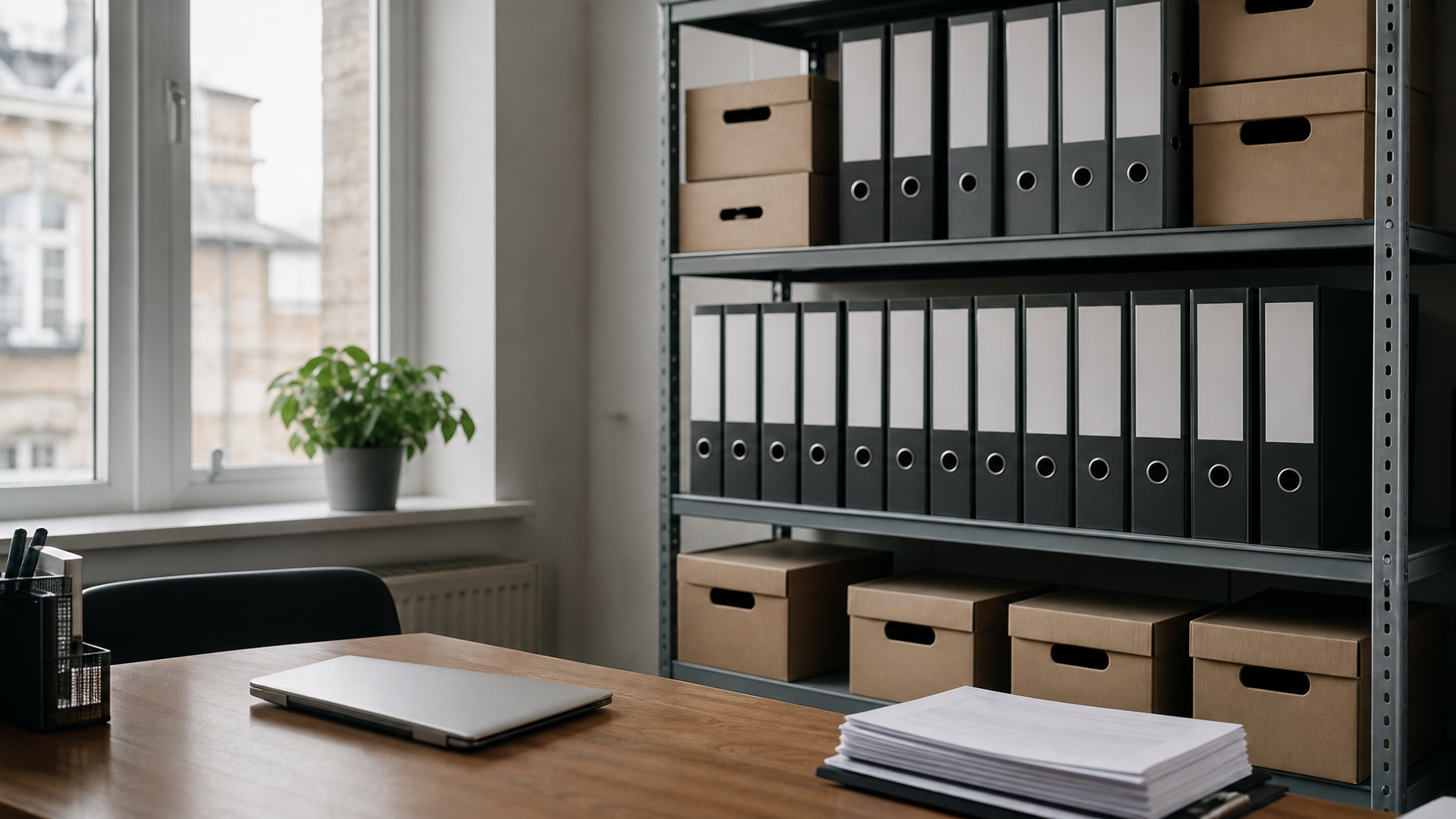
A hazardous waste register is the set of hazardous waste records a business keeps about the waste it produces, holds, carries or receives. In England, the register is made up of consignment notes, consignee returns and related documents such as carrier schedules and records of rejected loads. Producers and holders keep it for 3 years, carriers for one year, and consignees for a period that depends on the type of site and its permit.
This guide focuses only on the records side of the rules. For an overview of every duty that applies to each role, see our guide to producers, holders, carriers and consignees.
What a hazardous waste register is
GOV.UK guidance on hazardous waste for producers and holders uses the word "register" to describe the records each business in the waste chain must keep. In practice, it is the collection of paperwork each business holds for the hazardous waste it deals with.
The rules described here apply in England, with the other UK nations covered further down.
What goes in the register
Producers and holders must keep their copies of:
- consignment notes, the documents that travel with each movement of hazardous waste
- consignee returns, which they receive from the businesses that take their waste
- any related documents, for example carrier schedules (a list of carriers where more than one is involved) and records of rejected loads
Carriers keep copies of consignment notes and the same kinds of related documents. If any of these documents are inaccurate or incomplete, both producers and carriers must keep a record of the missing information.
For background on when a consignment note is needed in the first place, see do I need a consignment note.
Records kept by consignees
A consignee is the business that receives, treats or disposes of hazardous waste. The GOV.UK consignee guidance lists a wider set of records for these sites:
- consignment notes
- related documents, such as carrier schedules and records of rejected loads
- a site inventory recording where waste was stored, treated or disposed of at the site, kept in a secure, marked area that is accessible in emergencies
For landfill and other permanent storage (disposal codes D1 to D6 and D12, known as tipped waste), the site inventory must be a site plan divided by a grid or contour lines. It shows where hazardous waste is located, with its consignment note code and a waste description that includes the waste classification code, chemical components and hazardous properties.
For other operations, such as treatment, recovery and incineration, the inventory can be a site plan or a table. Consignees also keep a record for each delivery of hazardous waste they accept, covering its weight in kilograms, its waste description, the name, address and postcode of the producer or holder it came from, and the disposal or recovery method applied.
How long to keep hazardous waste records in England
Retention periods depend on the role a business plays:
- producers and holders: 3 years
- carriers: one year
- waste dealers and brokers: 3 years for the copies of records they obtain from producers or holders
- consignees at landfill sites (D1 to D6 and D12): all records for as long as the site has a permit
- consignees at other permitted sites: consignment notes for 5 years, and the site inventory and all other records for as long as the site has a permit
- consignees at sites with an exemption: all records for 3 years
A consignee that gives up or loses its permit must send its records to the Environment Agency.
Where records must be kept
The location of the register also depends on the role:
- producers and holders keep records at the premises that produced or stored the waste
- carriers keep records at their head office
- consignees keep records at the site where the hazardous waste was stored, treated or disposed of
Consignee returns to the Environment Agency
Consignee returns are reports on hazardous waste received, treated or disposed of by a consignee. In England, consignees send them every quarter to both the Environment Agency and the producer or holder of the waste. Separate returns go to each, and a copy of the same document cannot be sent to both.
Producers and holders need these returns to keep their records. Returns that do not arrive can be requested in writing, and the guidance refers producers to the Environment Agency if a waste business does not provide them. The deadline for each quarter is published in the GOV.UK guidance.
Waste transfer notes for non-hazardous waste
Non-hazardous waste is documented differently. Under the waste transfer note guidance, each load moved off a business's premises needs a waste transfer note, or a document with the same information such as an invoice. Both the business and the business taking the waste keep a paper or electronic copy for 2 years, and show it to an enforcement officer from the local council or the Environment Agency if asked.
Where a season ticket (sometimes called an annual waste transfer note) covers repeated transfers for up to a year, the season ticket and its schedule are kept for 2 years after the last transfer. Our guide to the duty of care covers the wider obligations behind these notes.
Records in Scotland, Wales and Northern Ireland
Each nation has its own regulator and paperwork. For a broader comparison, see hazardous waste rules across the UK nations.
- Scotland: the Scottish Environment Protection Agency (SEPA) regulates what Scotland calls special waste. All special waste produced in Scotland must be consigned using a special waste consignment note (SWCN) bearing a unique SEPA-issued code, and SEPA currently asks for completed notes to be submitted electronically.
- Wales: Natural Resources Wales (NRW) receives quarterly hazardous waste consignee returns, due within one month of the end of each quarter. A return is required even when no hazardous waste was dealt with in that period.
- Northern Ireland: the Northern Ireland Environment Agency (NIEA), part of the Department of Agriculture, Environment and Rural Affairs (DAERA), issues and administers consignment notes with unique codes. Its guidance notes that the regulations include requirements for record keeping and periodic inspections of waste producers' facilities.
Retention periods and record formats in these nations are set by their own regulations, so the England figures above do not automatically apply. Where a situation is unclear, speak to our team.
Our collection services
We collect a range of hazardous waste streams for businesses, including through our chemical waste disposal, oil disposal and solvent disposal services. In England, hazardous waste travels with a consignment note until it reaches its destination, and the producer's copy of that note forms part of its own register.
Speak to our team
To discuss your waste, contact our team on 0845 366 9306 or email enquire@hazardousdisposal.co.uk.
This article is for general information only and does not constitute professional, legal or chemical advice. Waste producers are legally responsible for correctly classifying their waste. For guidance on your specific waste, please contact our team.